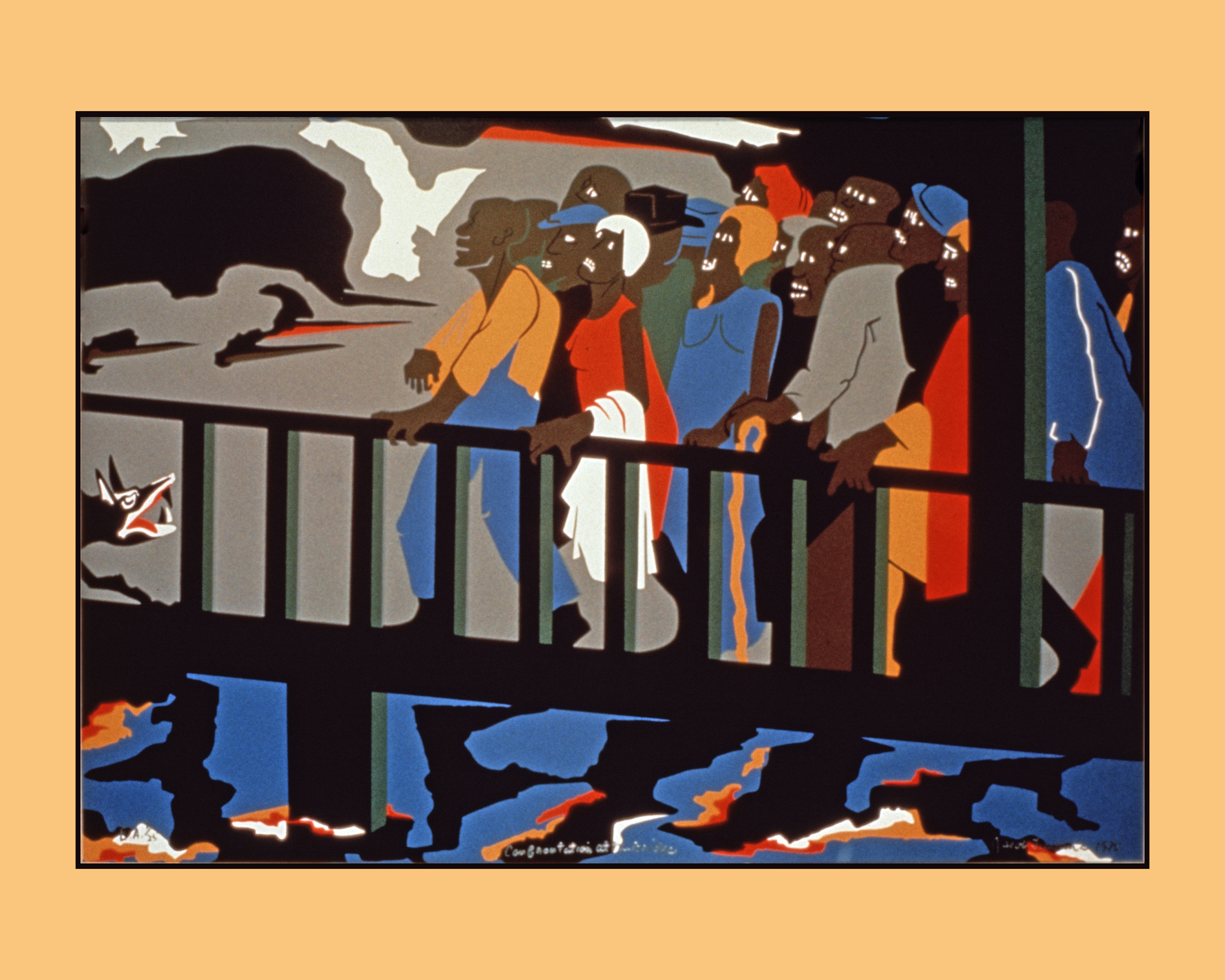
Born in Atlantic City, New Jersey, Lawrence grew up in Harlem during the Depression. Harlem was an active cultural center then, and Lawrence became interested in the arts while still a teenager. He received early training at art workshops sponsored by the federal government’s Works Progress Administration (WPA) in Harlem and then studied at the American Artists School in New York. From 1938 to 1939, Lawrence worked in the Federal Arts Project and produced some of his earliest major works. His first important solo exhibition in 1944, at New York’s Museum of Modern Art, secured his place as an important commentator on the American scene, particularly African American experiences. Lawrence died on 9 June 2000.
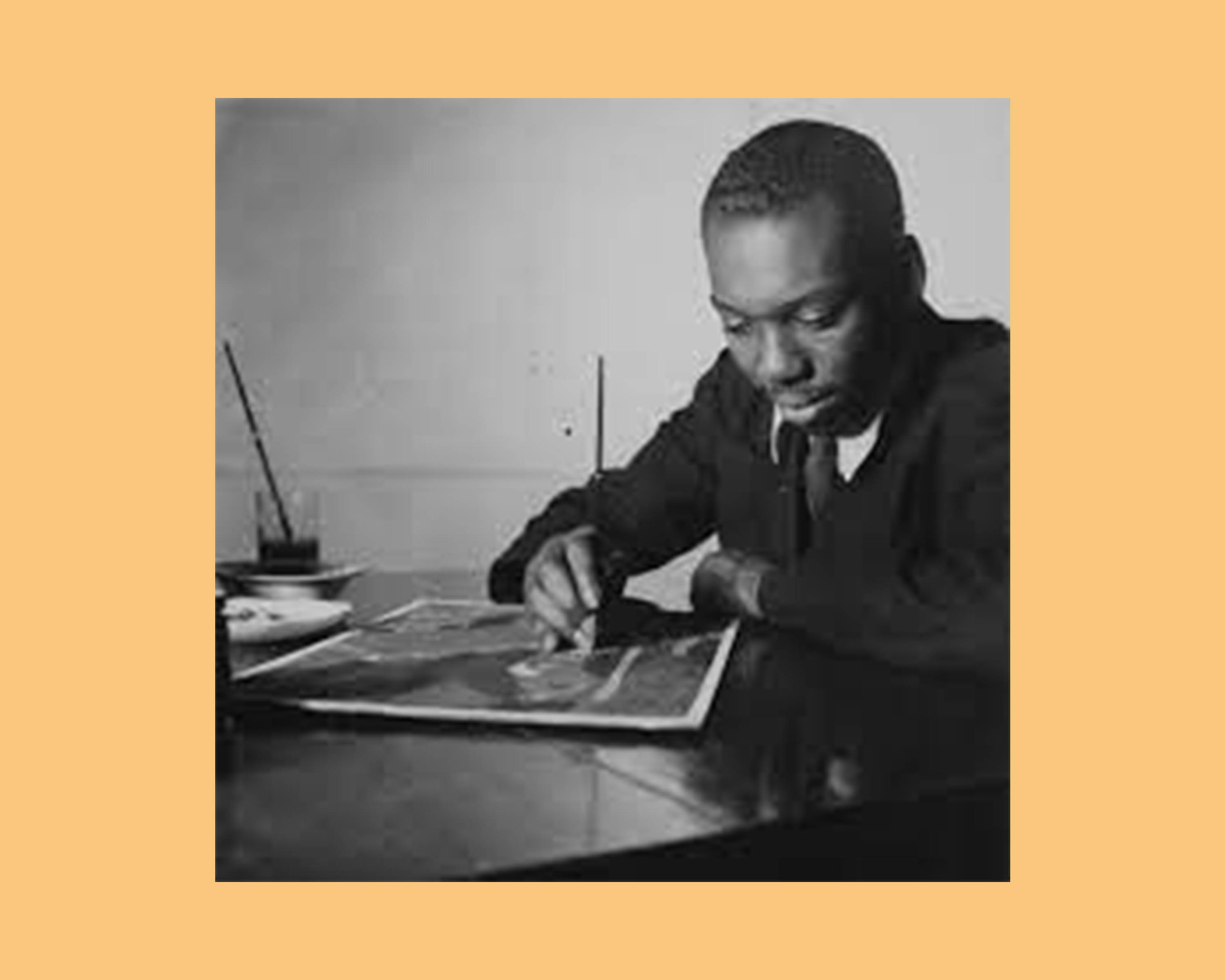
Jacob Lawrence with a panel from the Frederick Douglass series, c. 1939. Harmon Foundation Collection, National Archives and Records Administration, College Park, Md.
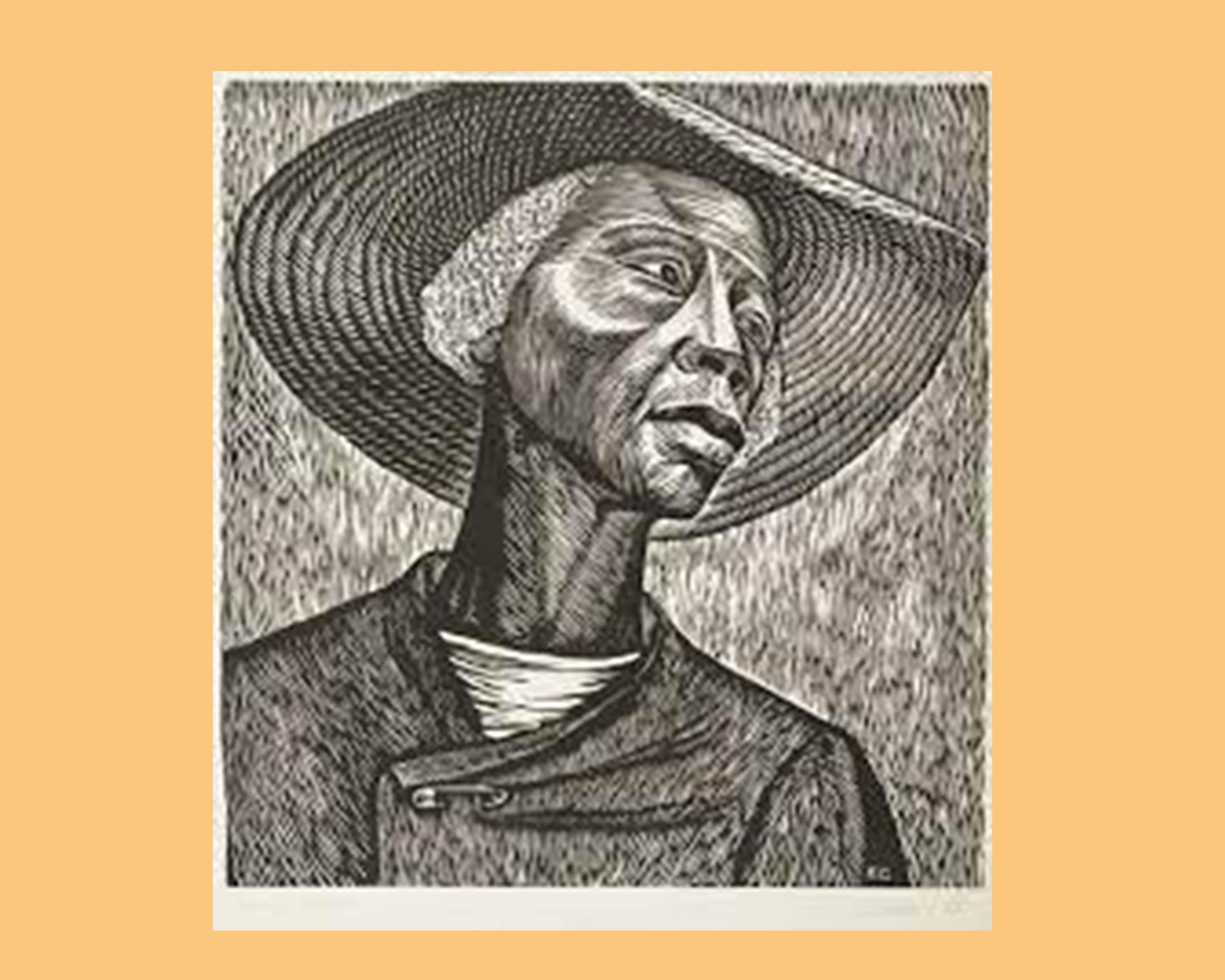
“Sharecropper” is a powerful portrait of an anonymous woman that calls attention to the hardships experienced by tenant farmers of the American South, who were required to pay for the land they rented with part of their crop and thus often faced lifelong debt. She created “Sharecropper” at the Taller de Gráfica Popular (People’s Graphic Workshop) in Mexico City, which was dedicated to the production of socially engaged prints.”
Elizabeth Catlett’s artwork and life painted a noble and human way of life for African American and Mexican working-class women. Her work tells accurate stories of their lives.
She was born in the United States in Washington, DC, in 1915. Raised by her mother because her father died shortly after she was born, Catlett spent summers with her grandparents in North Carolina.
She graduated from Howard University with a degree in Art and the University of Iowa with a Masters in Fine Arts degree. In 1940, she got a job as the department chair of Art at Dillard in New Orleans.
The first female professor of sculpture at the National Autonomous University of Mexico, School of Fine Arts San Carlos, in Mexico City, Catlett taught there until she retired in 1975.
Her work is collected in America, Mexico and the Czech Republic.
In addition to supporting marginalized communities in protests marches, Catlett was also commissioned to create monuments for the Ralph Ellison, Louis Armstrong and at Howard University. Social justice was a matter that filled her work with images of Dr. Martin Luther King, Jr., Black Power and other African American figures.
General Moses is a drawing by Charles White of Harriet Tubman. She sits on these rocks like she is on a throne, giving counsel to many. The first time I saw this I remember thinking wow, what a powerful woman this was. This is an ink drawing created by Charles White in 1965.
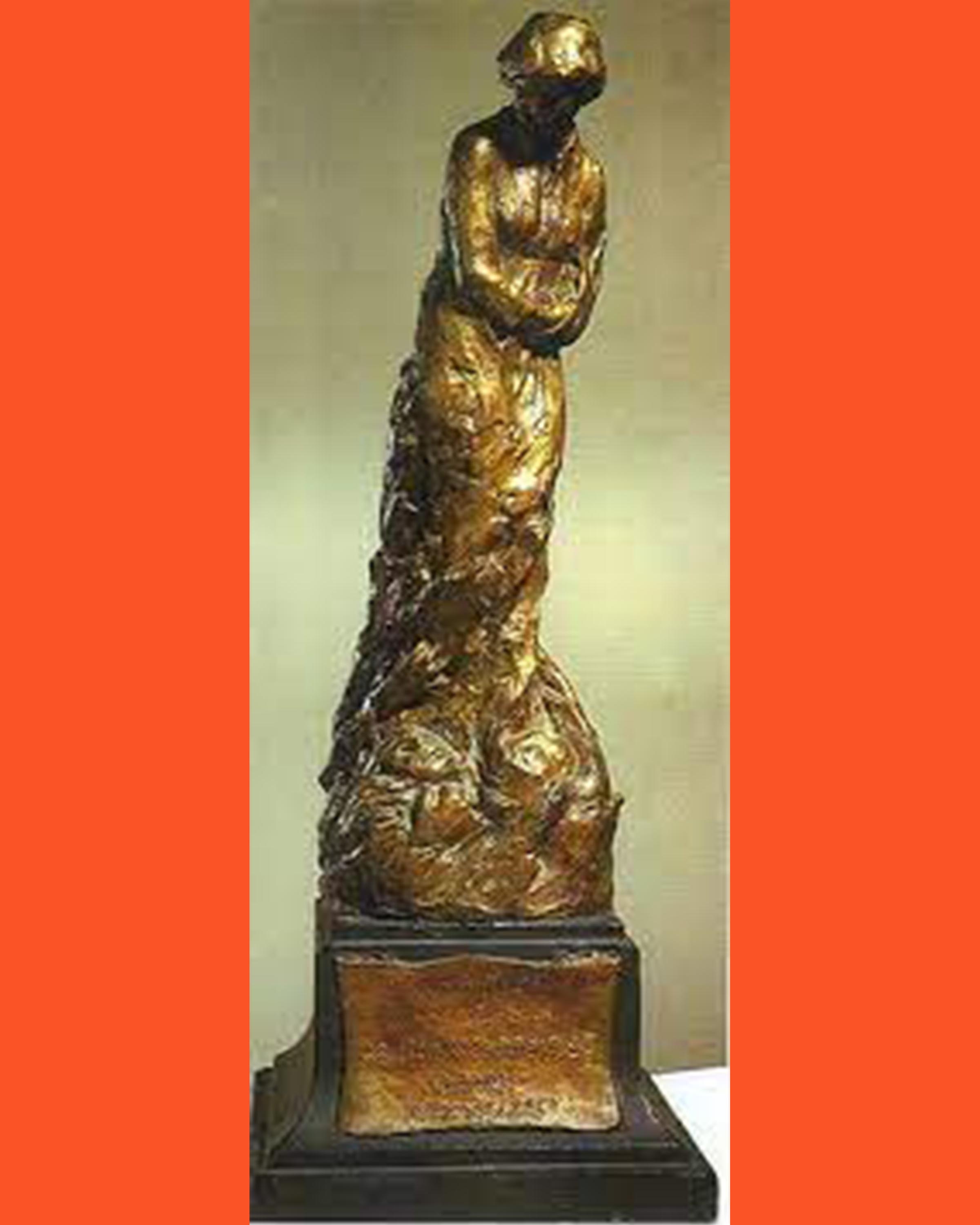
Mother and Child Sorrow by Meta Vaux Warrick Fuller in 1962 and is a bronze cast sculpture. I love that a woman was creating art that spoke to the abuse African Americans received during that time in history. Cheers to women who tell our stories by any means.
When I first saw this work by Warrick I thought WOW.
In Memory of Mary Turner: As a Silent Protest Against Mob Violence
This sculpture, depicting a woman cradling an infant in her arms and leaning away from grasping hands and flames at the base, was created in response to the vicious lynching of a young woman named Mary Turner in 1918. Mary Turner’s husband had been lynched and she publicly denounced his murder. In response, a mob of hundreds captured her, hung her upside down from a tree, and brutally killed her and her unborn child.
Artist Meta Warrick Fuller’s sculpture is one of the first created by an African American specifically depicting the brutality of lynch mobs.
Museum of African American History, Boston & Nantucket
African American stories were not told during her time. At least not the truth. She became known for using her work to address social injustice towards African Americans during her lifetime. Meta Vaux Warrick Fuller was a poet, painter and sculptor at the turn of the 20th Century. Born in Philadelphia in 1877, her parents were able to send her to a good school which helped develop her artistic ability. Her parents were part of the African American middle class with successful businesses.
Fuller’s work was shown in high school projects at the 1893 World’s Columbian Exposition in Chicago. She received a scholarship to a university and after graduation, she moved to Paris, France to study with Raphael Collin. Henry Ossawa Tanner, the first African American painter to gain international fame, was also a family friend.
In 1907 Fuller won a gold medal for her work in an exhibition at the 1907 Jamestown Tercentennial. She created 150 dioramas depicting the progress African Americans had made from when slaves landed in Jamestown to the beginning of 1900.
I am not completely sold on it, but the new Wonder Years which is being produced by Lee Daniels has Don Cheadle narrating and stars Dule Hill. The premise is interesting, but this can go two ways. I am waiting to see which one. But check it out and let me know what you think.
What twelve years of education and mandatory classes failed to do, can be done in a matter of moments with the right singers and directors.
And the answer to the unasked question is teach American citizens how government works.
In the new offering titled We The People executive producers President Barack and Michelle Obama, Kenya Barris and Chris Nee tell strong stories that explain the Bill of Rights, Immigration, Taxes and so much more. It reminds me of that Saturday morning cartoon School House Rock but gives me so much more.
The wide range of directors telling the stories made it interesting and made me want to see what each brought to the table. It was nice to see some of the characters in non traditional roles. It was good to see all types of people represented.
One of my favorite episodes was about taxes. Everyone hates to pay them, but love the benefits of them. We spend everything we got hitting those well paved roads across America. We love the library system, couldn’t live without some of the regulations. It is great that there is something that puts everything in perspective at a level that even a child can understand it.
I thought the art was beautiful. The music made me dance. It also reminds me to be an active citizen. As everyone should be. But also remember you need to be an informed active citizen.
The music was amazing and it took me back. How about y’all?
Remember the time when all of the food had been cooked, everyone was getting ready to play cards, and they put the records on the player. Everyone in the room knew all the worlds to all the songs.
This past weekend, which was also Easter weekend, the guys at Versuz served up some music and memories. More important they taught us some history we need to hear right from the horses mouth.
On Instagram it was supposed to be an epic battle between two historic R&B bands: Earth Wind & Fire v The Isley Brothers. The way it works is they have the bands side by side and they play hits from each other to see which is the greatest.
Not how it went off.
We danced and sang for almost four hours Sunday evening. Everyone sang with every song. Those old dudes got stamina, cause I was ready for bed by 10, but Ron Isley was still standing and singing with his cane in hand.
Philip Bailey, of Earth Wind & Fire was still throwing that falsetto at us.
Earth Wind and Fire was a band founded in 1969 by Maurice White. It has won Grammys, American Music Awards but more important to me, has created music that shaped my life.
The Isley Brothers started in the 1950s with brothers, O’Kelly, Rudolph and Ronald. Their first big hit was Shout! in 1959. This is a song that had shape many a party.
Epic doesn’t even describe this versuz battle. I loved the music. I loved the live social media chats. I too wanted Steve Harvey to shut up, cause I was tired of our drunk uncle.
The best part was the storytelling from the bands. It was good to hear that they were all friends, but you could see that as they sang each other songs. It was good to hear how a song was made or why. It just added another level of love for the music.
It is always good to hear our history from our people.
It is part of the National Geographic SeriesGenius. Season One was neat. Season two not so much. Season three is a Kaw Pow! Each season has a different character and focus.
In Season Three, Genius sets out to tell the story of Aretha Franklin, with all of the great music and moments from history.
Shaian Jordan plays Aretha when she is young, giving the audience a view of life on the gospel circuit. She is adorable and makes you believe she is the young Aretha Franklin. Older Franklin is portrayed by Cynthia Erivo who can take us to church, but also remind us why she was the “Queen of Soul.”
Now, I am not saying I believed every part of the story they told. I am saying it is entertaining and has great moments. Franklin is more than a woman who just wants to be a great singer. She is a woman who wants to make an impact.