Add some fruit to your diet
slavery




We Speak

It Started Earlier Than You Thought
Women wore their hair in a natural style for a fashion show. It was a contest that gave a cash prize for the winner. These women were sporting natural beauty before it was in fashion

A group of young men started an organization called the African Jazz At Society (AJAS) in the late 1950s. Kwame Braithwaite wanted to capture the essence of jazz in Harlem in photography. He wanted his audience to feel it and hear it through his work.

in the 1960s The Grandassa Models was formed to champion African inspired clothing and black beauty according to Tanisha Ford who has written a wonderful history of the experience.
Pushing The Limits
She was nice named the Black Greta Garbo, and one look at her proved why. She dispelled the myth at African Americans were ugly, untalented and stupid.
Nina Mae McKinney had starred in an all African American cast show, Hallelujah. The amazing job she did in that show, gained her a contract from MGM. It turned out to be a hollow victory. They only offered her roles as maids and servants, and never any lead roles.
McKinney was not the only African American who refused to deal with the hand she was dealt in the entertainment industry. Josephine Baker received a scathing review from a mainstream newspaper critic who called her homely and untalented. But in France, she became an icon by singing, dancing and pushing her talent to new limits

Our beauty has pushed through a lot of pain, but it has pushed through.
Art of the Month
The Crown

Ordinary
Africans from the regions of Gambia and Senegal were captured by slavers in 17th Century and sold into French America. They were smart individuals who understood agriculture and could adapt their skill sets in slavery. Even though they purchased their freedom from slavery, found themselves as part of a permanent slave class which even restricted how they looked.
They had to keep their hair covered according to the law.

She was probably one of the most popular images of African American women in the late 19th Century which eluded to something other than beauty. She was popular and became an icon that would last for centuries. She would become a symbol of beauty in a different way.
Nancy Green was born a slave in 1834 in Kentucky. After slavery she got a job in Chicago taking care of children and cooking for privilege families. Later she got a job with the Davis Mill Company being the spokesperson for Aunt Jemima Pancakes. They put her face on the package.
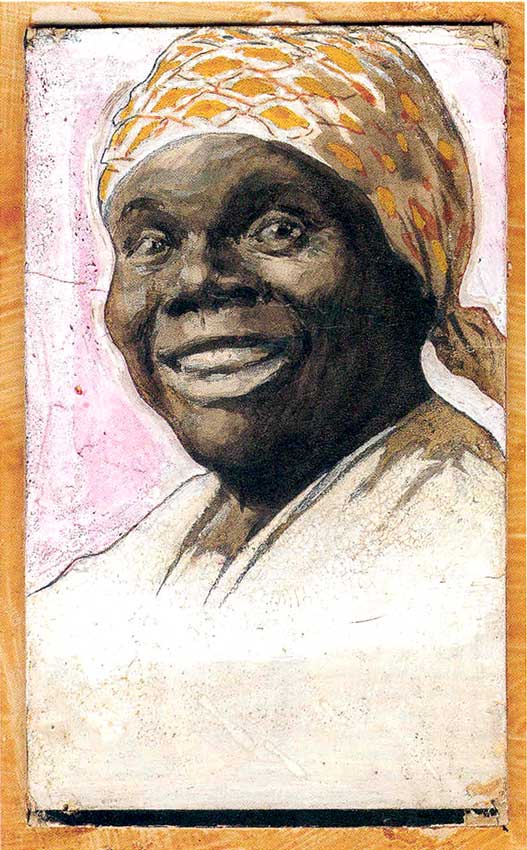
In the month of April we will examine African American beauty
Postcard Art
Homage, my tribute to Aaron Douglas’s work during the Harlem Renaissance is now available on a post card for $10.
Homage is among the art featured in Wordpeace Online. You can view a copy of that issue at http://www.wordpeace.co

If you would like to purchase a post card of this work we accept PayPal, Venmo and the Cash app.
Pray and Protect Civil Rights
Pray that the case going before the court will protect the people. Pray that good will triumph over evil.
Supreme Court is hearing this case of Byron Allen v Comcast. Comcast want to change the law so that it will be impossible to ever use racial discrimination in a law suit again.
Lets show them that prayer works.

Art of the Month: Juneteenth
This month we tip our hat to those who burned a path for us to follow.

Fascinating Places
2019 will be a fascinating journey for me. It has started with a bang. I have spent the first part of January reading books that take me deep into the jungles of the African continent. I read the story of one of the last people brought to the United States on a slave ship. He spoke of what his life was like before being captured. He spoke of his family and their customs, the rituals to become a man and get married.
More important, he spoke of the process of being captured to be a slave and what it was like watching everyone he loved being murdered. Like the author of the book, for many years I thought that the Europeans had seized the Africans from their native homes. But in Barracoon by Zora Neal Hurston, the old African man told a different story.
He spoke of other African tribes who ruthlessly killed entire villages just to capture the young and strong people to sell to the Europeans. These killers left their regular way of life, which was farming, to become slavers. Motivated by greed, they created soldiers that could terrorize and take out a whole village. These soldiers were paid by the number of heads they brought back. The skulls were collected as a prize by their king.
It made me think. As these greedy people sold off all of their strength for material wealth, they were not prepared to fight the colonization that would overtake and suppress them. It reminds me that the greedy people today won’t get away with their evil deeds. They are just getting prepared to be undone by something more evil than themselves.
Another book took me into a different part of the continent. I loved reading how Nelson Mandela’s father was the family historian. He could recount the family’s history for hundreds of years, yet he could read or write. Our history was repeated by word of mouth through the generations.

It reminded me of my own family who would sit and tell stories of the way it used to be. Even today I question older relatives to the point of annoyance because I want to know more. I want to know what it was like and what they did. But I am finding that some of the secrets older people tried to keep, are coming to light.
But this part of the journey makes me appreciate a history told orally and through art, like masks and other sculpture. It tells us what is beautiful. What is powerful. What is important. The thing I appreciate about African Art is that it finds beauty in the work. It is not an exact replica of someone or something. It just is.
We need to do the same. We need to tell our children the stories orally of our family. We need to create art that represents what legacy we leave behind. Many of the previous generations of my family were poor and undereducated. They did not think they were leaving much behind, but the truth is they left a lot.
I love the story Nelson tells of the first pair of pants he wore. They were not a brand new pair fresh from the tailor. They were an old pair of his father’s pants. His father cut them off so they would fit, and used a rope around the waist to hold them up. Nelson said it was one of the proudest moments of his life.
Think about what legacy you are leaving your family. What kind of objects are you making to represent it? Do your children know your family’s story? Do you? Remember when you carve out your part of your family history, it does not have to look like someone else’s. Like the African mask, it only represents what you want it to.
 UPP Creative Media